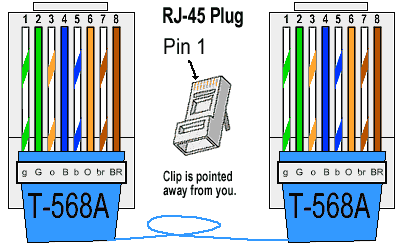
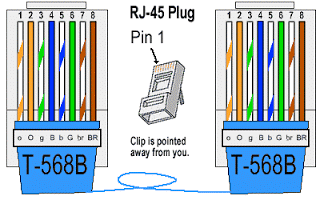
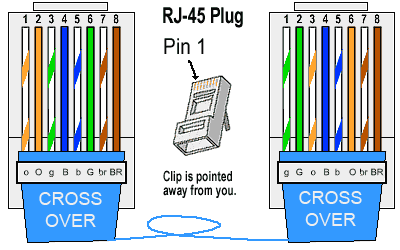
ETHERNET CABLE COLOR CODING DIAGRAM

Ethernet Cable Color Coding Diagram for:

  • Category-5 cables
  • Category-5E cables
  • Category-6 cables
  • Category-6E cables

The information listed here is to assist network administrators in the color coding of Ethernet cables. Please be aware that modifying Ethernet cables improperly may cause loss of network connectivity. Use this information at your own risk, and ensure all connectors and cables are modified in accordance with standards. The Internet Centre and its affiliates cannot be held liable for the use of this information in whole or in part.

The TIA/EIA 568-A standard which was ratified in 1995, was replaced by the TIA/EIA 568-B standard in 2002 and has been updated since. Both standards define the T-568A and T-568B pin-outs for using Unshielded Twisted Pair cable and RJ-45 connectors for Ethernet connectivity. The standards and pin-out specification appear to be related and interchangeable, but are not the same and should not be used interchangeably.

Both the T-568A and the T-568B standard Straight-Through cables are used most often as patch cords for your Ethernet connections. If you require a cable to connect two Ethernet devices directly together without a hub or when you connect two hubs together, you will need to use a Crossover cable instead.

A good way of remembering how to wire a Crossover Ethernet cable is to wire one end using the T-568A standard and the other end using the T-568B standard. Another way of remembering the color coding is to simply switch the Green set of wires in place with the Orange set of wires. Specifically, switch the solid Green (G) with the solid Orange, and switch the green/white with the orange/white.

Ethernet Cable Instructions:

  • Pull the cable off the reel to the desired length and cut. If you are pulling cables through holes, its easier to attach the RJ-45 plugs after the cable is pulled. The total length of wire segments between a PC and a hub or between two PC’s cannot exceed 100 Meters (328 feet) for 100BASE-TX and 300 Meters for 10BASE-T.
  • Start on one end and strip the cable jacket off (about 1″) using a stripper or a knife. Be extra careful not to nick the wires, otherwise you will need to start over.
  • Spread, untwist the pairs, and arrange the wires in the order of the desired cable end. Flatten the end between your thumb and forefinger. Trim the ends of the wires so they are even with one another, leaving only 1/2″ in wire length. If it is longer than 1/2″ it will be out-of-spec and susceptible to crosstalk. Flatten and insure there are no spaces between wires.
  • Hold the RJ-45 plug with the clip facing down or away from you. Push the wires firmly into the plug. Inspect each wire is flat even at the front of the plug. Check the order of the wires. Double check again. Check that the jacket is fitted right against the stop of the plug. Carefully hold the wire and firmly crimp the RJ-45 with the crimper.
  • Check the color orientation, check that the crimped connection is not about to come apart, and check to see if the wires are flat against the front of the plug. If even one of these are incorrect, you will have to start over. Test the Ethernet cable.

Ethernet Cable Tips:

  • A straight-thru cable has identical ends.
  • A crossover cable has different ends.
  • A straight-thru is used as a patch cord in Ethernet connections.
  • A crossover is used to connect two Ethernet devices without a hub or for connecting two hubs.
  • A crossover has one end with the Orange set of wires switched with the Green set.
  • Odd numbered pins are always striped, even numbered pins are always solid colored.
  • Looking at the RJ-45 with the clip facing away from you, Brown is always on the right, and pin 1 is on the left.
  • No more than 1/2″ of the Ethernet cable should be untwisted otherwise it will be susceptible to crosstalk.
  • Do not deform, do not bend, do not stretch, do not staple, do not run parallel with power cables, and do not run Ethernet cables near noise inducing components.

My Favorite Foods!

Sinigang sa miso

Ingredients

  • 3 salmon heads cut lengthwise into half
  • 2 25g pack Knorr Sinigang na May Miso Recipe Mix
  • 1 bunch mustard leaves
  • 12 pieces okra
  • 2 medium tomato wedged
  • 3 pieces long green peppers
  • 2 medium yellow onion wedged
  • 6 to 8 cups water
  • 1/2 teaspoon ground black pepper
  • 2 to 3 tablespoons fish sauce patis

Instructions

  1. Pour water in a cooking pot. Let boil.
  2. Add onion and tomato. Let the water- re-boil.
  3. Put the salmon heads into the pot. Stir.
  4. Once the water starts to boil once more, add Knorr Sinigang na May Miso Recipe Mix. Stir.
  5. Add the long green peppers. Cover and then cook in medium heat for 12 minutes.
  6. Add okra, ground black pepper, and fish sauce. Stir. cover and cook for 5 minutes.
  7. Add the mustard leaves. Cover and cook for 3 to 5 minutes.
  8. Transfer to a serving bowl. Serve.
  9. Share and enjoy!

Adobong Pusit

This Filipino squid dish uses the adobo method  (cooking meat in a soy sauce-and-vinegar mixture) and squid is simmered until the liquid becomes a savory-sour sauce. It’s a well-loved dish for a reason: it’s easy-to-make plus it has all the familiar sweet, sour, and savory adobo flavors we love. Bookmark this recipe and serve the dish on your next big family meal. 

It’s easy to overcook the squid: remember to let it simmer just until the squid is cooked through.

Adobong Pusit (Squid Adobo) Ingredients

3 tablespoons cooking oil

4 cloves garlic, minced

1 white onion, finely chopped

1 kilogram squid (pusit), sliced with squid ink set aside

2 tablespoons soy sauce

4 tablespoons vinegar

salt, to taste

How to Cook Adobong Pusit (Squid Adobo)

Saute garlic and onions in a wok with cooking oil.

Add the sliced squid along with the squid ink and water. Boil until the squid is cooked through.

Add the soy sauce and vinegar. Season with salt and pepper.

Let it simmer for 5-10 minutes or until the sauce is thick.

Tinolang manok

Ingredients

  • 1 tablespoon oil
  • 1 small onion, peeled and sliced thinly
  • 2 to 3 cloves garlic, peeled and minced
  • 2 thumb-sized fresh ginger, peeled and julienned
  • 1 (3 to 4 pounds) whole chicken, cut into serving pieces
  • 2 tablespoons fish sauce
  • 5 cups water
  • 1 small green papaya, pared, seeded and cut into 2-inch wedges
  • 1 bunch fresh spinach leaves, stems trimmed
  • salt and pepper to taste

Instructions

  1. In a pot over medium heat, heat oil. Add onions, ginger and garlic and cook until limp and aromatic.
  2. Add chicken and cook, stirring occasionally, for about 5 to 7 minutes or until chicken starts to change color and juices run clear. Add fish sauce and cook, stirring occasionally, for about 1 to 2 minutes.
  3. Add water and bring to a boil, skimming scum that float on top. Lower heat, cover and simmer for about 30 to 35 minutes or until chicken is cooked through.
  4. Add papaya and cook for about 3 to 5 minutes or until tender yet crisp. Season with salt and pepper to taste. Add spinach and cook until just wilted. Serve hot.

Kinilaw na tanique

Calamansi (which is scientifically known as Calamondin) is a small fruit that looks like key lime. This has a sour juice with a mild bitter taste. It is a popular souring agent in Filipino cuisine and one of the best ingredients when making Filipino fish ceviche or kilawin.

The key in making the best kinilaw is to choose the freshest ingredient. The fish that I used were fresh from the market. This was made when I was in the Philippines for a few weeks. I was too excited to make this dish using the freshest fish and calamansi (since I am deprived of fresh calamansi here in the Midwest).

All the ingredients should be well blended. My technique is to combine all the ingredients in a bowl (except the fish) and stir everything until well blended. The mixture will be poured over the fish to absorb at the same time. Adjustments such as addition of salt and calamansi can be done later.

Kinilaw na Tanigue Recipe 

Ingredients

  • 2 lbs. Tanigue Wahoo fish, fillet and cut into cubes
  • 2 thumbs fresh ginger minced
  • 8 pieces hot chili Thai chili or siling labuyo, chopped
  • 15 to 20 pieces calamansi
  • 1 medium red onion chopped into small pieces
  • ¼ teaspoon ground black pepper
  • ½ teaspoon sugar
  • Salt to taste

Instructions

  1. Squeeze the juice out of the calamansi over a large bowl. Use a sieve to filter the seeds. Discard the seeds.
  2. In the bowl with calamansi juice, add sugar, ½ teaspoon salt, and ground black pepper. Stir until the sugar and salt are diluted.
  3. Add the ginger, chili, and onion. Stir for a few seconds until all ingredients are well blended.
  4. Arranged the raw fish cubes in a large bowl. Pour the calamansi mixture. Toss until the fish cubes are coated. Let is stay for 10 minutes.
  5. Toss one more time and taste. Add more salt if needed. You can also add more calamansi juice if needed. Toss to blend all the ingredients. Securely cover the bowl and place it inside the refrigerator. Let it chill for at least 3 hours.
  6. Serve. Share and enjoy!


Basic Soccer Rules

No Hands, please

First, the rule for a hand ball includes using any part of the body from the tips of thefingers to the shoulder. Second, the proper way to look at this soccer rule is that aplayer cannot “handle” the ball. A ball that is kicked and hits a player’s hand or armis not a hand ball. This means that the referee must judge whether or not a hand ballis accidental contact or the player handled the ball on purpose to gain an advantage.There is also a situation in which the goalie cannot use his/her hands. This issometimes called the back-pass rule. Goalkeepers cannot pick up a pass that camedirectly from one of their teammates. In this case, the goalkeeper must use his feet.If the goalie does pick-up the ball it will result in an indirect kick from where he/shetouched the ball.

Throw-ins

A throw-in is taken when the ball crosses a sideline and leaves the field. The twobasic soccer rules for a proper throw-in are to have both feet on the ground and tothrow the ball with both hands over the head.

Corner Kicks & Goal Kicks

A corner kick or goal kick is taken when the ball leaves the field across the goal line– the end of the field. If the offensive team kicks it out, play is restarted with a goalkick. If the defensive team kicks it out, play is restarted with a corner kick. The goalkick is taken from anywhere inside the “goal area box”. It can be taken by anyplayer. The ball must leave the “Penalty Area” before anyone can touch the ball. Ifthe ball does not leave the Penalty Area then the kick must retake. The corner kick istaken from the corner nearest to where the ball left the field.

Fouls

The common rule of thumb on fouls is “If it looks like a foul, it probably is.”A player cannot kick, trip, jump at, charge, strike, push, hold, or spit at an opponent.Bumping, leaning or going shoulder-to-shoulder while competing for a ball is not afoul until the hands or elbows come up.

Direct and Indirect Free Kicks

The simple difference between the two is this: On a direct kick you can score bykicking the ball directly into the goal. On an indirect kick you cannot score. Anindirect kick must be touched by another player before it can go into the goal – thatis the kicker and a second person. You can tell whether the kick is direct or indirectby looking at the referee. For an indirect kick, the referee will hold one arm straightup in the air until the second person touches the ball. No arm up or pointing towards the goal, it’s a direct kick. In general, a direct kick comes from a contact foul or handball. Everything else is indirect.

Penalty Kick

A penalty kick results from a contact foul or hand ball by the defending team withinthe penalty area – the large box on either end of the field. So it’s a type of directkick also. The ball is placed on the penalty spot, in front of the center of the goal. Allplayers must remain outside the penalty area and the penalty arc until the ball iskicked. The goalkeeper must have both feet on the goal line until the ball is kicked. Ifafter the ball is kicked, it rebounds off of the goal or the keeper and stays on thefield, the ball is “live” and anyone can play it.

Two-touch Rule

A player cannot touch the ball twice in a row when putting the ball in play. You willsee this called many times in youth soccer. It applies everywhere. You will see itfrequently on kick-offs or direct and indirect kicks. If a player barely hits the ball anddecides to take another kick at it, that is a two-touch. This also applies to throw-ins.A player cannot throw the ball in and then kick it.

Offside

You cannot be offside on a corner kick, goal kick, or throw-in. Also, it is not anoffense for a player to be in an offside position. The player must be involved in activeplay as determined by the referee to be called offside.

A player is in an offside position if: he is nearer to his opponents’ goal line thanboth the ball and the second last opponent.

Basic Volleyball Rules and Terminology

Basic Volleyball Rules

  • 6 players on the floor at any one time – 3 in the front row and 3 in the back row
  • Maximum of 3 hits per side
  • Points are made on every serve for wining team of rally (rally-point scoring).
  • Player may not hit the ball twice in succession. (A block is not considered a hit.)
  • Ball may be played off the net during a volley and on a serve.
  • A ball hitting a boundary line is in.
  • A ball is out if it hits an antennae, the floor completely outside the court, any of the net or cables outside the antennae, the referee stand or pole, the ceiling above a non-playable area.
  • It is legal to contact the ball with any part of a player’s body.
  • It is illegal to catch, hold or throw the ball.
  • A player cannot block or attack a serve from on or inside the 10-foot line.
  • After the serve, front-line players may switch positions at the net.
  • Matches are made up of sets; the number depends on level of play. 3-set matches are 2 sets to 25 points and a third set to 15. Each set must be won by two points. The winner is the first team to win 2 sets. 5-set matches are 4 sets to 25 points and fifth set to 15. The team must win by 2 unless tournament rules dictate otherwise. The winner is the first team to win three sets.

Basic Volleyball Rule Violations

Rule violations that result in a point for the opponent

  • When serving, the player steps on or across the service line as while making contact with the ball.
  • Failure to serve the ball over the net successfully.
  • Ball-handling errors. Contacting the ball illegally (double touching, lifting, carrying, throwing, etc.)
  • Touching the net with any part of the body while the ball is in play.
  • When blocking a ball coming from the opponent’s court, it’s illegal to contact the ball when reaching over the net if both your opponent has not used 3 contacts AND they have a player there to make a play on the ball.
  • When attacking a ball coming from the opponent’s court, contacting the ball when reaching over the net is a violation if the ball has not yet broken the vertical plane of the net.
  • Crossing the court centerline with any part of your body is a violation. Exception: if it is the hand or foot. In this case, the entire hand or entire foot must cross for it to be a violation.
  • Serving out of rotation/order.
  • Back-row player blocking (deflecting a ball coming from the opponent) when, at the moment of contact, the back-row player is near the net and has part of his/her body above the top of the net. This is an illegal block.
  • Back-row player attacking a ball inside the front zone (the area inside the 3M/10-foot line) when, at the moment of contact, the ball is completely above the net. This is an illegal attack.

Basic Volleyball Terminology

A

Ace: A serve that results directly in a point, usually when the ball hits the floor untouched on the receiving team’s side of the court.
Assist: Helping a teammate set up for a kill.
Attack: The offensive action of hitting the ball.
Attacker: Also “hitter” and “spiker.” A player who attempts to hit a ball offensively with the purpose of terminating play.
Attack Block: The defensive team’s attempt to block a spiked ball.
Attack Error: An attack botched in one of 5 ways: ball lands out of bounds; ball goes into net; attacker commits center line or net violation or attacker illegally contacts ball.
Attack Line: A line 3 meters/10 feet away from, and parallel to, the net. Separates the front-row players from the back-row players. A back-row player cannot legally attack the ball above the net unless he takes off from behind this line.

B

Back row/court: Space from baseline (endline) to attack line. There are 3 players whose court positions are in this area (positions 1, 6 & 5 on court)
Back Row Attack: When a back-row player takes off from behind the attack line (10-foot/3-meter) line and attacks the ball. Various terms A-B-C-D-PIPE-BIC.
Back set: Set delivered behind the setter.
Baseline: The back boundary of the court. Also called the end line
Block: One of the 6 basic skills. A defensive play by one or more front-row players meant to intercept a spiked ball. The combination of one, 2 or 3 players jumping in front of the opposing spiker and contacting the spiked ball with the hands.
Blocking Error: Touching the net, crossing the centerline, blocking a set or serve or any other “local” violation that occurs while making a block attempt.

C

Center line: The boundary that runs under the net and divides the court into two equal halves.
Closing the block: The responsibility of the assisting blocker(s) to angle their body relative to the first blocker.
“Cover”: Refers to the hitter having his/her teammates ready to retrieve rebounds from the opposing blockers.
Cross-court attack: An attack directed diagonally from the point of attack. Also called an angle hit.
Cut shot: A spike from the hitter’s strong side that travels at a sharp angle across the net.

D

Deep: Refers to sending the ball away from the net, toward the baseline of the opponent’s court.
Defense: One of the 6 basic skills. The key skills used to receive the opponent’s attack are digging and sprawling. The dig resembles a forearm pass from a low ready position and is used more for balls that are hit near the defender. The sprawl is a result of an attempted dig for a ball hit farther away from the defender. It resembles a dive.
Dig: Passing a spiked or rapidly hit ball and low to ground. Defensive play. Slang for retrieving an attacked ball close to the floor. Statistically scored on a 3.0 point system.
Dink: A one-handed, soft hit into the opponent’s court using the fingertips. Also called a tip.
Double block: Two players working in unison to intercept a ball at the net.
Double hit: Violation. Two successive hits by the same player.
Down Ball: Type of attack. “Down” refers to the blockers who neither jump, nor raise their hands above the net.
Dump: Usually performed by the setter, who delivers the ball into the opponent’s court on the second contact.

F

Five-One (5-1): An offensive system that uses five hitters and one setter.
Floater: A serve with no spin so the ball follows an erratic path.
Follow: To move with and block an attacker. Athletes may change positions with another blocker in the process.
Forearm Pass: Sometimes referred to as the “pass,” “bump” or “dig”.
Four-Two (4-2): An offensive system using four hitters and two setters.
Free ball: Returning the ball to the opponent without the intent to get a kill. Usually a slow, arcing pass or “roll” shot rather than a spike.
Front: Position of a blocker so that she/he can block the attacker.
Front-row: Three players whose court position is in front of the attack line (3M/10 Foot), near the net. These players are in positions 2, 3 & 4 on the court.

G

Game plan: Offensive and defensive emphasis for an opponent. Usually organized for each rotation by the coaching staff.

H

Held ball: A ball that comes to rest during contact resulting in a violation.
Hit: One of the 6 basic skills. To jump and strike the ball with an overhand, forceful shot.
Hitter: Also “spiker” or “attacker.” The player who is responsible for hitting the ball.
Hitting percentage: A statistic derived from total kills minus total attack errors, divided by total attempts.

J

Joust: When 2 opposing players contact the ball simultaneously above the net causing the ball to momentarily come to rest; the point is replayed if this is called by the official.
Jump serve: The server uses an approach, toss, takeoff and serves the ball with a spiking motion while in the air. There are two main types: jump float, jump spin.

K

Key player/play : To discern a team’s best player or probable next play by observation of patterns or habits.
Kill: An attack that results directly in a point or sideout.

L

Libero: A player specialized in defensive skills. This player must wear a contrasting jersey color from his or her teammates and cannot block or attack the ball when it is entirely above net height. When the ball is not in play, the libero can replace any back-row player without prior notice to the officials.
Lines: The marks that serve as boundaries of a court. 2 inches (5cm) wide.
Linesman: Officials located at the corners of the court; each linesman is responsible for ruling if the ball is legally in play along the lines for which he or she is responsible. For indicating touches and play outside of the antennae on their side of net.
Lineup: Players starting rotation and, therefore, serving order. Numbered 1,2,3,4,5,6.
Line serve: A straight-ahead serve landing near the opponent’s left sideline.
Line shot: A ball spiked along an opponent’s sideline, closest to the hitter and outside the block.
Load: Body position for the blockers so that they are most effective.

M

Middle back: A defensive system that uses the middle back player in 6 to cover deep spikes. Also called “6 back” defense.
Middle blocker: Usually plays in the middle of the net when in the front row and moves laterally to her blocking assignments.
Middle Up: A defensive system that uses the middle-back player in 6 to cover tips or short shots along the 3 meter/10 foot line. Also called a “6 up” defense
Mintonette: The original name of the game of volleyball, created by William Morgan.

N

Net Height: Women – 7 feet, 4-1/8 inches high (2.24m),
Men – 7 feet, 11-5/8 inches high (2.43m).

O

Off-blocker: Outside blocker not included in the double block. Also called off-side blocker.
Off-Speed Shots: An attack that is intentionally slow. Ball spiked with less than maximum force but with spin. Also called “roll” shot.
Opposite: Player who plays opposite the setter in the rotation. In some systems, this player is also a setter. In other systems, this player is called a right-side.
Outside hitter: Usually plays at the ends of the net when in the front row. Also called right-side (opposite) or left side (power).
Overhand pass: A pass with both hands open that is controlled by the fingers, with the face below the ball. Both hands simultaneously contact the ball above the head and direct it to the intended target.
Overhand serve: Serving the ball and striking it with the hand above the shoulder. Float or spin.
Overlap: A violation called if a team is lined up out of rotation when the ball is served.
Overpass: A ball passed across the net.
Overset: An errant set that crosses the net without being touched by another offensive player.

P

Pass: One of the 6 basic skills. Receiving a serve or the first contact of the ball with the intent to control the ball to another player. Also called a “bump”.
Pancake: One-hand floor defensive technique where the hand is extended and slid along the floor palm down while the player dives or extension rolls so the ball bounces off the back of the hand and is considered legal.
Party ball: When the ball is passed across the net in front of attack line so the front-row attacker can immediately hit the ball on the first contact.
Penetration: The blocker’s ability to reach over the net above the opponent’s court.
Perimeter: Backcourt defense where 4 players arrange themselves near the boundaries of the court.
Pipe: A back-row attack from the middle of the court. Position 6.
Play: An attack with a planned fake, usually including 2 or more hitter.

Q

Quick set: An extremely low vertical set used to beat the opponent’s block. Can be set at any position on the net.

R

Rally scoring: Scoring method where points can be won by the serving or receiving team.
Ready position: The flexed, yet comfortable, posture a player assumes before moving to the point of contact.
Red card: Given by the official to a player or coach for flagrant misconduct resulting in a point/side out to the opponent. Results in automatic ejection and a point/side out for the opponent.
Roof: To block a spike, usually straight down for a point.
Rotation: The clockwise movement of players around the court and through the serving position following a side out. Players must retain their initial rotational order throughout the entire game, but once the ball is contacted on serve they are allowed to move anywhere.

S

Seam: The mid-point between 2 players.
Serve: One of the 6 basic skills. Used to put the ball into play. It is the only skill controlled exclusively by one player.
Set: One of the 6 basic skills. The tactical skill in which a ball is directed to a point where a player can spike it into the opponent’s court. Sets can be set at different heights and different locations on the net and offensively there are names for each of these. First number is location on net and second number height of set. (Example: 13.) Sets can also be named.
Set attack: When a setter attempts to score rather than set the ball to a setter. Also called a shoot set. Setter: The second passer whose job it is to position a pass to the hitter.
Shallow: Near the net.
Shank: Severely misdirected pass.
Side out: Change of service when a serving team has failed to score a point. Occurs when the receiving team successfully puts the ball away against the
serving team, or when the serving team commits an unforced error.
Six-pack: Being hit in the face with the ball.
Six-two (6-2): An offense with four spikers and two spiker/setters. Setter comes from the back row.
Slide/step: A quick attack behind the setter.
Spike: Also called a hit or attack. A ball contacted with force by a player on the offensive team who intends to terminate the ball on the opponent’s floor or off the opponent’s blocker.
Split block: A double-block that leaves a space between the blockers.
Stuff: A ball deflected back to the attacking team’s floor by the opponent’s blockers.
Substitution: Allows one player to replace another player already on the court. Rules dictate number of subs each team is allowed.
Switch: To change court positions after a ball is served to facilitate strongest player positions.

Table Tennis Rules

What you need to know to play a fun game of ping-pong

Sometimes all you want to know are the basic rules to play a friendly match of ping pong. This section is for you. However if you want the official rules, then read this.

In singles, the center lines serve no purpose, so ignore them.

Scoring

A match is played best 3 of 5 games (or 4/7 or 5/9). For each game, the first player to reach 11 points wins that game, however a game must be won by at least a two point margin.

A point is scored after each ball is put into play (not just when the server wins the point as in volleyball).

The edges of the table are part of the legal table surface, but not the sides.Flow of the match

Each player serves two points in a row and then switch server. However, if a score of 10-10 is reached in any game, then each server serves only one point and then the server is switched. After each game, the players switch side of the table. In the final game (ie 5th game), the players switch side again after either player reaches 5 points.Legal serve

The ball must rest on an open hand palm. Then it must be tossed up at least 6 inches and struck so the ball first bounces on the server’s side and then the opponent’s side.

If the serve is legal except that it touches the net, it is called a let serve. Let serves are not scored and are reserved.Equipment

The paddle should have a red and a black side. The ball should be either orange or white and 40 mm in size. The table should be 2.74 meters long, 1.525 m wide, and 0.76 m high.

Beautiful Places in the Philippines

1. El Nido, Palawan

El Nido is one of the must-visit and must-return places in the Philippines in 2016. When in El Nido, experience different island hopping tours to white sand beaches, enchanting lagoons, and crystal clear waters, where you can swim, snorkel, do kayaking, or just relax and embrace the hidden beauty of Mother Nature.

2. Boracay Island, Aklan

Boracay is probably the most popular beach island in the Philippines. It’s every Filipino’s dream to visit this island located in the province of Aklan. With its soft white sand, bright blue waters, beautiful sunset view, and unforgettable night life experiences

3. Batanes Islands, Batanes

Batanes is one of the most wanted tourist destinations in the Philippines. A trip to the province will give you the most unique sceneries of the country, which include unspoiled islands that will satisfy nature lovers, livestock freely roaming above endless green hills, massive cliffs overlooking oceans under the blue skies, rocky shores and white sand beaches, and the rich cultural heritage of the Ivatans.

4. Camiguin Island, Camiguin

Camiguin province holds the record of having the most number of volcanoes per square kilometer than any other island on the planet. But beyond volcanoes, the province also boasts natural attractions, including an uninhabited white sandbar, hot and cold springs, and waterfalls. Moreover, you can also witness the Lanzones festival in October, visit centuries-old churches, old ancestral homes and the infamous sunken ce

5. Malapascua Island, Cebu

Along with Palawan and Boracay, the island of Cebu is also considered one of the top 20 best islands in the world by Condé Nast Traveller magazine. A month isn’t enough to explore the whole of Cebu, which is known for its white beaches, luxury resorts, and rich history. Malapascua Island is one of the most popular destinations in Cebu. The small island which can be walked around in two hours is home to lovely beaches and relaxing breeze of air. Tourists visit the island for a once-in-a-life time diving experience with the thresher sharks.

There is a lot more of tourist spot here in the philippines! you should explore the Philippines.

Why it’s More Fun in the Philippines

 “It’s More Fun in the Philippines”. But many people wonder is it really more fun in the Philippines? What’s so special about the country? Well, aside from the friendliness and hospitality of the Pinoys and the Pinays (which are Filipino slang for Filipino men and women respectively), there are so many activities that you can do in this small country. Their national language is Tagalog, or Filipino, but you don’t have to learn it so that you can enjoy in the Philippines. This is why it is always a good idea to visit the many Pinoys and Pinays of the Philippines.

The most famous tourist spots in the Philippines are water bodies. There they have hundreds of great beaches that have the finest white sand. There are rivers and gigantic lakes that are rich in history too. The favourite tourist destination of many people is the island of Boracay. Well, we all know what this island offers, right? Basically the Boracay Island, which is found in the Visayas islands of the Philippines, is the home of the finest white sand that doesn’t even get hot no matter how hot the sun may be. Yes, this is true. The island is also home to many different activities that everyone can participate in. In the evening, the island becomes the hottest party place as the shore is lined up with bars and the like.

However, if you are more into the solitude and relaxation kind of vacation, you can always go to any island in Palawan. This is an island in the Philippines that is known to be an animal sanctuary. There are many different land and sea animals present there. It is also home to many different beaches and dive spots that will really make your vacation in the Philippines one to remember. Indeed, it is more fun in the Philippines.

If you want to be near the beach but would like to be in a city as well, you can always go to Cebu. This is a city that has the best beaches minutes away from its center. Many Pinoys and Pinays love to live here, actually as it definitely defines what a paradise in the metro is. The language of the people here is not Tagalog, though. Their main dialect is called Visaya. However, you shouldn’t worry because the second language of the Pinoys and the Pinays here is English. Therefore, you can rest assured that when you visit this part of the Philippines you will be able to roam around without getting lost. You will surely be able to enjoy the place.

If you are into hiking and trekking, the Philippines have a lot to offer as well. The small archipelago is home to many mountains and volcanoes that any thrill seeker will enjoy. Sure enough, no matter what age you are or no matter what kind of mountain you would want to climb, the Philippines will be able to offer you the most wonderful time. This is why more and more people are visiting the Philippines. Aside from the friendly Pinoys and Pinays that are willing to be your guide, you will be astonished with the untouched beauty of most of the mountains and volcanoes that they have.

The Philippines is also the home of one of the new 7 wonders of the world, the Subterranean River Park. Basically, this is a river that is under a cave of limestone and such. Many Pinoys and Pinays offer tours here that the whole family will surely enjoy. After your trip of the Subterranean River Park, you can enjoy swimming and feeding the fishes in their marine sanctuary. You will be surprised with how colourful and vivid these corals and marine animals are. This is one reason why it is more fun in the Philippines.

It is more fun in the Philippines because of the diverse activities that you can do here. The Philippines is not a huge country. You can travel from the north to the south in less than a month – even when you are spending quality time in each of their tourist spots. Tagalog or not, you will be able to communicate well with the Pinoys and Pinays there, which will guarantee you that it is indeed more fun in the Philippines.